

I’ve never felt so happy to be alive as when I landed in Jakarta. This had mostly to do with the fact I’d recovered from E. coli about 12 hours before the flight and was just jazzed to no longer feel like gnomes were siphoning off my blood in my sleep. When I go back someday, I’ll be happy when I land because Indonesia is a wonderful place where I was treated with more genuine kindness than probably anywhere else. What follows, however, is not an account of that; what follows is an account of the idiosyncrasies one random visitor found weird, funny, or otherwise notable.
When you arrive in Indonesia, the first thing you notice is smoke. Apparently, lighting things on fire is a national pastime. The forests are on fire to clear land, the cleared land is on fire to fertilize the fields, and trash is on fire everywhere (presumably to get rid of the trash and not for fun). For good measure, everyone is smoking. It’s not like with wildfires where you just can’t breathe; rather, it’s like being near a campfire at all times, downright pleasant if you don’t dwell on what it might be doing to you.
Once you toughen up your lungs and explore a bit, you may be struck by how warm everyone is. By many accounts, Indonesia is a friendly country but it’s not the superficial niceness you get from a barista or a Midwesterner. It seemed more like a genuine regard for visitors: People’s faces would light up when they asked how I liked it there and I responded, “I love it.” I was clearly not from around the area, so managers at restaurants would check with my party to see if I was enjoying the food. It was very sweet. Also, of course I was enjoying it because the cuisine (more like 100 different cuisines really) is amazing.1 We wandered into the middle of a pretty animated protest in Jakarta (with the frenzy of mopeds, crossing the street is more of something you do on a dare). As people saw us trying to get through with luggage, to a man they smiled, stopped what they were doing, and politely made space for us, resuming chanting only after we’d gotten through.
The language has the term “rubber time,” which I assumed would mean things tended to be late.2 As experienced, it’s more that things expand to fill the available space. A friend of a friend takes you to lunch, learns that you don’t have plans after, and so she rearranges her day to show you around all afternoon. The downside to this is a certain aimlessness in group settings. Everyone wants a nap but is too polite to break off company, so you end up wandering around a mall for two hours.
There’s also the term bule,3 which, roughly translated, means foreign white guy.4 As one, I came away from the trip really not sure what celebrities are always complaining about. People wanted photos of me, with me, of me with their babies. There’s a selfie of me with a janitor in the new high speed rail station bathroom. It’s awesome! It’s like being the mayor but with no pesky responsibilities. There was but a slight pang of jealousy when a group of schoolchildren, after some debate, opted for a photo with a 7’ tall middle aged Australian man instead of me.
I’m struck by descriptions of Tokyo where people remark on how quiet the city is. Indonesian cities are decidedly not like that. The busyness is exciting, but there’s noise. Noise, noise, noise. Sometimes it’s a characteristic you get used to, even nostalgic about. The constant hum of moped engines for instance; a sort of background music. Other times, you wonder how anyone could put up with such a racket without going insane. The train station in Yogyakarta is a case in point: there’s the train traffic, train arrival/departure announcements so consistent it’s not clear where one ends and another begins, the moped engines, the car horns, music over the PA system, and… and, inhumanely, there’s the tinny 1990s era synthed up version of the Westminster Quarters clock tones. Only, the chime of the hour never arrives. I think they’re used to announce when a train is entering or exiting the station. But, they’re so long that they just run together for each train. They never end! So, over the din of everything else, you hear:
Bong, bong, bong, bong
Bong, bong, bong, bong
Bong, bong, bong, bong
Bong, bong, bong, bong
[this is where the clock is supposed to chime, but it never happens]
Bong, bong, bong, bong
Bong, bong, bong, bong
Bong, bong, bong, bong
Bong, bong, bong, bong
[still no chime]
Bong, bong, bong, bong
[…forever…]
Exiting the station I remarked, “it’s a cacophony in there”.
And the response was, “oh, really? I hadn’t noticed”.
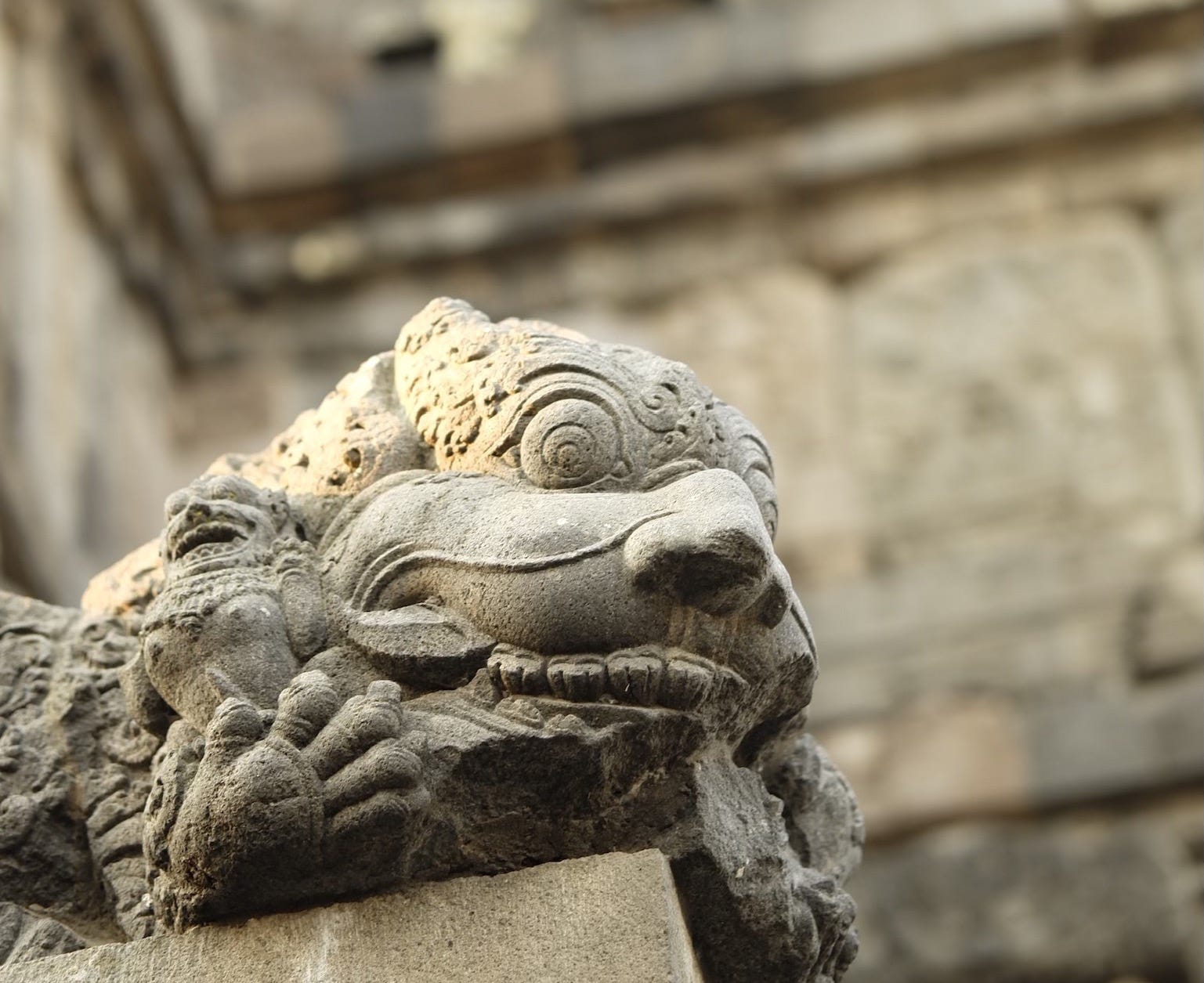
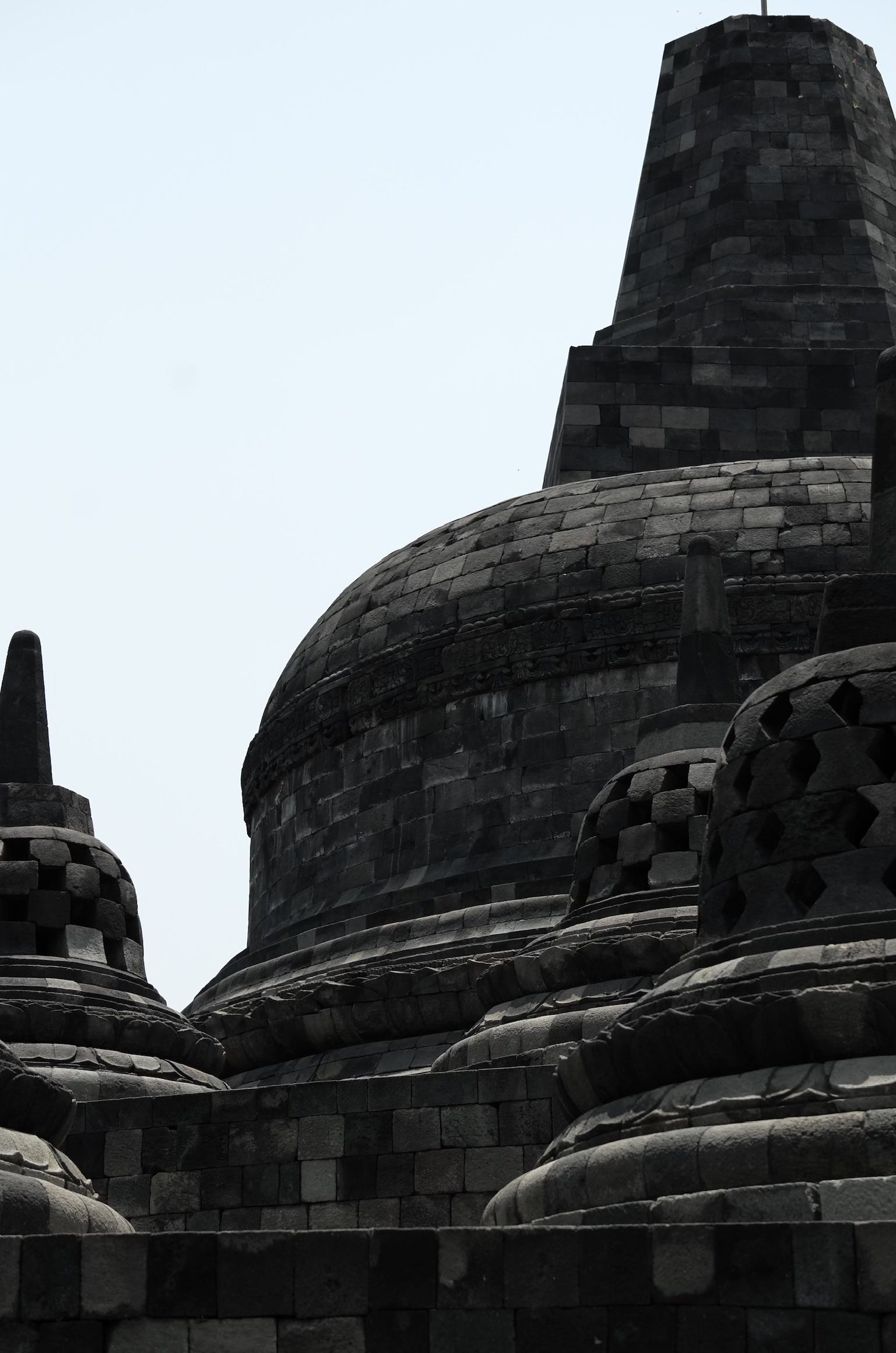
Speaking of Yogyakarta, the city has two of the most impressive pieces of architecture I’ve ever seen. And, I’d have never known about either if someone hadn’t remarked on a whim, “he should go see Borobudur”. Borobudur is the largest Buddhist temple in the world and is impressive in its enormity at a distance and in its detail up close. The Prambanan is a large Hindu temple, only partially restored. It’s more whimsical than monumental, and the grounds make for a nice walk at dusk. There are periodic evening Javanese ballet shows at the Prambanan, and I happened to catch a performance of the Ramayana. It was a bit like a community theater5 in that the actors seemed like they had day jobs and the production was modest; it was nothing like community theater in that all the performers were talented, the style of dance was very cool, and everyone seemed to be having fun. It would be worth planning a trip around the performance schedule.
I stayed in one of the nicer hotels6 in Yogyakarta and, when I went to turn the tap on, it dawned on me that a competent plumber would be worth his weight in gold. I didn’t encounter a working faucet the entire trip, not in hotels, nor restaurants, nor private homes, nor even the airport. Now, they weren’t broken in the sense that they sprayed water everywhere, leaked, or otherwise had an emergency issue. But they’re not anchored to the sink. Every time you touch one, the handle and faucet give and shake, like a turtle’s neck jutting in and out of the wall. It’s as though plumbing schools stop after explaining how to connect a spigot to pipes but before explaining how to keep it from dancing around.
Overall, if I must devote a sentence or two to things more important than faucet shakiness or train station announcements, Indonesia is, in the best of ways, not quite like anywhere else. It’s the sort of place you could spend a week and then miss for the rest of your life. Go if you get the chance. And try durian while you’re there.
Oh, also, if at any point you awake to a loud roar with sweaty palms and a visceral fear that a jungle cat is about to lunge at your throat from the darkness, don’t worry. That is the cry of an 8-12’’ long insect eating gecko.
Rental cars in Indonesia come with drivers. You could do a lot worse than to ask your driver for restaurant recommendations. Whatever you do, find some Padang food. Once you do, you’ll be sad the rest of your life that there aren’t very many Indonesian restaurants in the U.S.
A dream for someone chronically 10 minutes late to things.
Pronounced BOO-lay
It derives from a Javanese term for “albino,” which I guess is accurate in my case given my skin’s ghostly pallor.
Remember that one high school teacher who’d always try to organize field trips to community theaters, for which no one was interested? It was never clear why that guy – with interests including musicals, knitting, red wine, and pretending to read Proust – stuck around a school where the civics textbooks were old enough to still be warning of the Soviet menace, in a town where the only topics of conversation were football and nostalgia for the days of black lung.
This is not as extravagant as it sounds by American standards since Indonesia is a developing country. GDP per capita is ~$4,900 (or ~$17,000 at PPP) so a $90/night hotel is something like $1,500/night ($450/night using the PPP comparison) in relative terms to the U.S., where the GDP per capita is $85,000. I didn’t test this, but it’s probably rude to remark on how cheap upgrades/hotels/etc. are (a bit like spending $1,000 on a t-shirt without being at all conscious that it reads as out of touch).