

This piece was originally picked up as a freelance article for a NYC publication. However, when they saw the draft they decided it would be too “hard to find the bandwidth to edit this into usable shape.” Truly a ringing endorsement of my writing ability. Regrettably, there isn’t a single joke in the article; it’s an entirely earnest essay about trains. For that, I do apologize.
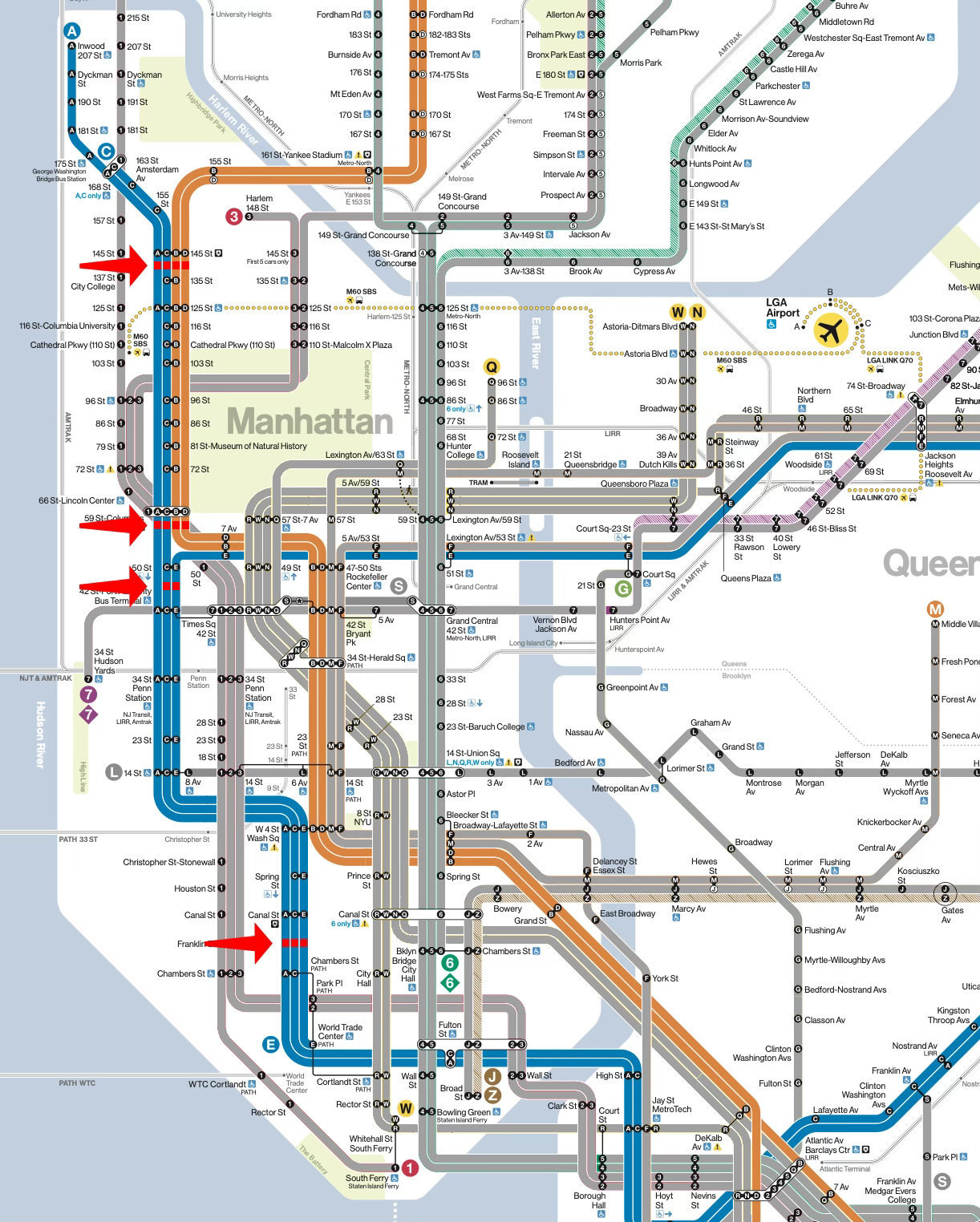
Suppose you need to get from upper Manhattan to visit a friend in Fort Greene Brooklyn. You board a southbound local C train at 155th street, intending to take it to Lafayette Avenue, 25 stops away. The trip should take 45 minutes. However, there are four different crossover points, or junctions, on the trip where other trains could delay you.1 You’re on the C, but the A/E and B/D trains move in front of you. These routes are all interlined, meaning they share track and a delay on one line can propagate to the others. But, why so many junctions? Could all of that be simplified?
De-interlining would entail adjusting subway routes so that they each share a minimum amount of track with each other. Such a change would eliminate merges, reducing the potential for delays on one line to spread to others. The 1 and the 2/3 are examples of de-interlined routes: The 1 train runs alongside the 2/3 but does not travel on the same track. In theory, this would allow for more frequent and reliable service. However, it would only come at the cost of revamping subway routes that New Yorkers have gotten used to over generations.
How did we get the current routes?
The A/C/E and the B/D are descendants of the publicly operated IND system. Peter Derrick, a transit historian and author, writes that it was “designed to compete with, rather than complement” the existing privately operated IRT2 and BMT3 transit system. Work was completed in stages, with the first being the Eighth Avenue trunk: Construction started in 1925 and by 1933 the Bronx and Manhattan sections were complete, operating as far south as Jay Street in Brooklyn. The next piece was the 53rd Street crosstown section (used today by the E and the B/D/M). This opened in 1933, operating from Roosevelt Avenue in Queens until it joined the Eight Avenue trunk at 50th Street. The Sixth Avenue trunk (today’s B/D/F/M) was next, with local service starting in 1936. However, the engineering for this last section was complex as the local tubes were wrapped around PATH tunnels while the express tracks had to be positioned below. As a result, the express tracks were not complete for decades.
The new system’s design was marvelous. All intersections are grade-separated or flying junctions, allowing trains to merge onto different lines without moving in front of other tracks (akin to merging from the leftmost lane on a highway to the rightmost but without ever crossing in front of the middle ones). This is why you notice trains moving up and down to get around each other when you travel between the 50th Street Station and 59th Street Columbus Circle. This was a major improvement over IRT system planning, where some crossings required, for instance, downtown traffic to stop before an uptown train could switch tracks. These are termed grade or conflicting junctions. An example is the 96th street station where the 2/3 splits from the 1. Until 1959, lines merged at that station; but the switch could not accommodate enough trains, snarling service so much that de-interlining was the only solution (this is why, today, the 1 does not share any track with the 2/3). The well-designed junctions on the IND are the reason that interlining is even an option. As new segments began operating, trains could merge into the existing ones with ease.
To some extent, today’s routes simply reflect the order in which the system was built. Eric Goldwyn, a professor at NYU’s Marron Institute of Urban Management, noted that there definitely is some “path dependence”, meaning the routes are what they are partly because there’s a natural resistance to changing a line once it opens. I also spoke with Joseph Raskin, author of a book on the history of New York City’s tumultuous subway construction and unrealized plans. During a wide-ranging conversation where he demonstrated an encyclopedic knowledge of every track, station, and rail yard in the system, he mentioned that many of today’s routes were designed to replicate long-gone elevated lines dating to the 1800s.
In other respects, routing reflects current service objectives. Goldwyn said that a “one-seat ride is a priority” for the MTA. He added that interlining can be useful for routes with high ridership in a central area and less demand near the ends. For instance, it makes sense for the 4/5 to be interlined in Manhattan (where ridership is high along the Lexington Avenue line, service must be frequent to avoid overcrowding) but to branch near the ends of the routes (where the risk of overcrowding is lower).
A Potential Simplification
Assuming a willingness to reconsider today’s routes, some degree of de-interlining is appealing because a simpler system is less prone to delay (and delays that do occur can be isolated). In turn, less volatile service allows for tighter schedules, which means service could be made more frequent. What’s more, in many cases, it would not require any new construction. In our IND example, the flying junctions allow for new routing without new track.
Reconsider our trip down the Eighth Avenue line on the C. If the A/C both ran express through Manhattan south of 145th Street and the B/D both ran local from 59th Street to 145th Street, no trains would ever need to cross onto each other’s track. Some riders would have to make more transfers4 but average trip times ought to fall because there would be fewer delays. Further, the simpler routes should allow the MTA to schedule more trains. One might have to transfer, but faster and higher frequency service would more than make up for that, or so the argument goes.
The morass of shared track – where the A merges with the D, which merges with the B, which merges with the C, which merges with the A and the E – would be reduced to a system where the A/C use the same track (likewise for the B/D) but no trains ever have to merge into each other’s path. It would, for example, be impossible for a delay on the A line to ripple into the E line. Today, that does happen because the A can delay the C, which can delay the E. Moreover, the A/C sharing track (and the B/D) would not add any complexity because these lines already share track elsewhere in the system.
The Tricky Details
For our example, the Eighth Avenue infrastructure could already accommodate de-interlining. However, there are other constraints in the system. Both Goldwyn and Raskin suggested that rail yard space might impede the MTA’s ability to run more trains per hour. Raskin mentioned that the last newly constructed rail yard was the Pitkin Yard in 1948, “I think” (he was right, although another one was converted for subway use in 1956). Goldwyn noted storage space is such a constraint that, on a practical level, it’s very difficult to even shut the system down (during a shut-down, empty trains still have to run because there isn’t enough room to park them all). This storage inflexibility means that trainsets may need to be matched to specific yards in a way that makes it difficult to increase service frequency.
Still other impediments come down to differences over what the MTA’s objectives should be. Goldwyn said there’s a tendency to focus on the biggest constraints. De-interlining some routes might be easy, but not attract attention because of more pressing, but harder to solve, issues (like the Nostrand interlocking that snarls 2/3/4/5 trains in Brooklyn). On interlining, his “impression is that there’s some disagreement between the younger generation and the old-timers,” with younger employees more open to de-interlining. He characterized the agency as averse to asking passengers to make transfers. For his part, he mentioned that a one-seat ride can be nice when one it lines up with where you’re going, but says “transfers are invariably part of a good transit system that offers anywhere-to-anywhere connectivity.” The type of transfer is important though: a cross-platform A to B switch at 59th Street is pretty painless, while a 2 to A transfer at Times Square is tedious since you have to take stairs, then more stairs, a corridor, a ramp, another corridor, followed by more stairs.
It’s also possible that the biggest stumbling block is inertia. Reasonable changes don’t always get traction. After all, it took a significant deterioration in service before the MTA checked to make sure it was using the correct speed limits as part of Andy Byford’s Save Safe Seconds campaign.
I asked for the MTA’s perspective on interlining, but their Media Relations department declined to comment or answer questions. An attempt to reach the Operations Planning department went unanswered as of this writing. A FOIL request for information turned up only one document, a project background summary from Byford’s Fast Forward initiative in 2018. It outlines a plan to study bottlenecks throughout the system to see if route changes could improve service (the Eighth Avenue example used here is mentioned specifically). The MTA is aware that putting multiple routes on the same track limits capacity and causes delays: “The act of throwing switches … to allow multiple routes to share tracks can itself reduce capacity…” and “any deviation from scheduled service can cause delays at key merge points, adversely affecting operational reliability.” The summary also notes that the agency’s highest concern about simplifying routes is “community pushback”. The project plan lists a 2019 completion date, but, as it was the only document provided, it’s not clear if it was ever carried out.
Yet…
There does seem to be some movement toward de-interlining at the MTA though. They recently announced that the F and the M will be switching places during rush hour to reduce merges on the Queens Boulevard interlockings. In a corresponding press release, the agency cited improved service reliability as the goal. Service will revert to the current pattern for evenings, nights, and weekends (“confusing” according to Raskin, who was unsure why they didn’t just make the change full time), so it’s a tentative step. Still, it is de-interlining in action. As another move in this direction, the agency’s new capital plan allocates money to revamp the Nostrand Interlocking (a notorious bottleneck); however, the resulting reconfiguration is planned to include route changes to reduce merges.
If these small changes reduce delays as much as hoped, perhaps we’ll see larger scale route adjustments. The knock-on effects could be substantial: fewer delays, the potential for more service, and the denser development more service would allow. Not a bad result for an operational change.
An example: At 135th street, you’re delayed by a late B train crossing onto the local track in front of your C train. You wait a bit then continue your trip. At 59th street, the late B train pulls into the station at the same time as a D train across the platform. The B/D lines use the same Sixth Avenue track so the B will have to wait for the D to move; you get stuck behind the B train again and have to wait too before you can proceed on the Eighth Avenue track. Once the B is out of the way, you continue as far as 50th street. Now though, your train is behind schedule, and an E is merging onto your track. You have to wait at 50th street. After that delay, you’re mostly alright, until you pull into Canal Street at the same time as an express A train. Below Canal, the A/C need to share track, so you’ll have to wait once again as the A train pulls out of the station ahead of you. This is a bad-luck scenario for subway delays, but it’s not unusual.
The numbered lines, as opposed to letters.
In Manhattan, the N/Q/R/W, L, and J/Z were formerly BMT lines.
e.g., getting from 23rd Street to 72nd Street would require a local E to express A/C to local B/D trip.